Saudi Arabia imports almost all of its plasma-derived medicines: immunoglobulins, albumin and clotting factors. Purchasing is centralized and efficient, and the prices it secures are competitive. But a good price is not the same as a guaranteed supply. When global plasma tightens, manufacturers decide who gets product first, and import-dependent markets wait.
That is why the Kingdom is weighing domestic production of essential medicines, plasma therapies among them, with two goals: self-sufficiency at home and a manufacturing hub for the region. United Plasma has worked this file on the ground: field studies of Saudi blood banks, working sessions with health officials, and the design of national plasma programs for governments across the region. This analysis sets out what has changed in the market, why regional demand will keep climbing, what a Saudi plasma program needs to succeed, how to add plasma donation without weakening the blood supply, and how each of these challenges is solved.
The hub model: a regional self-sufficiency loop
The idea is simple. A fractionation plant only works at scale, and no single country in the region yet collects enough plasma to fill one. Pooled, the region does. Partner countries collect plasma to one shared quality standard and send it to a Saudi plant. That volume fills the plant's capacity. The plant's output then fills the region's needs: each partner receives medicines made from its own plasma, the Kingdom secures its national supply, and the remaining capacity serves export markets beyond the region.
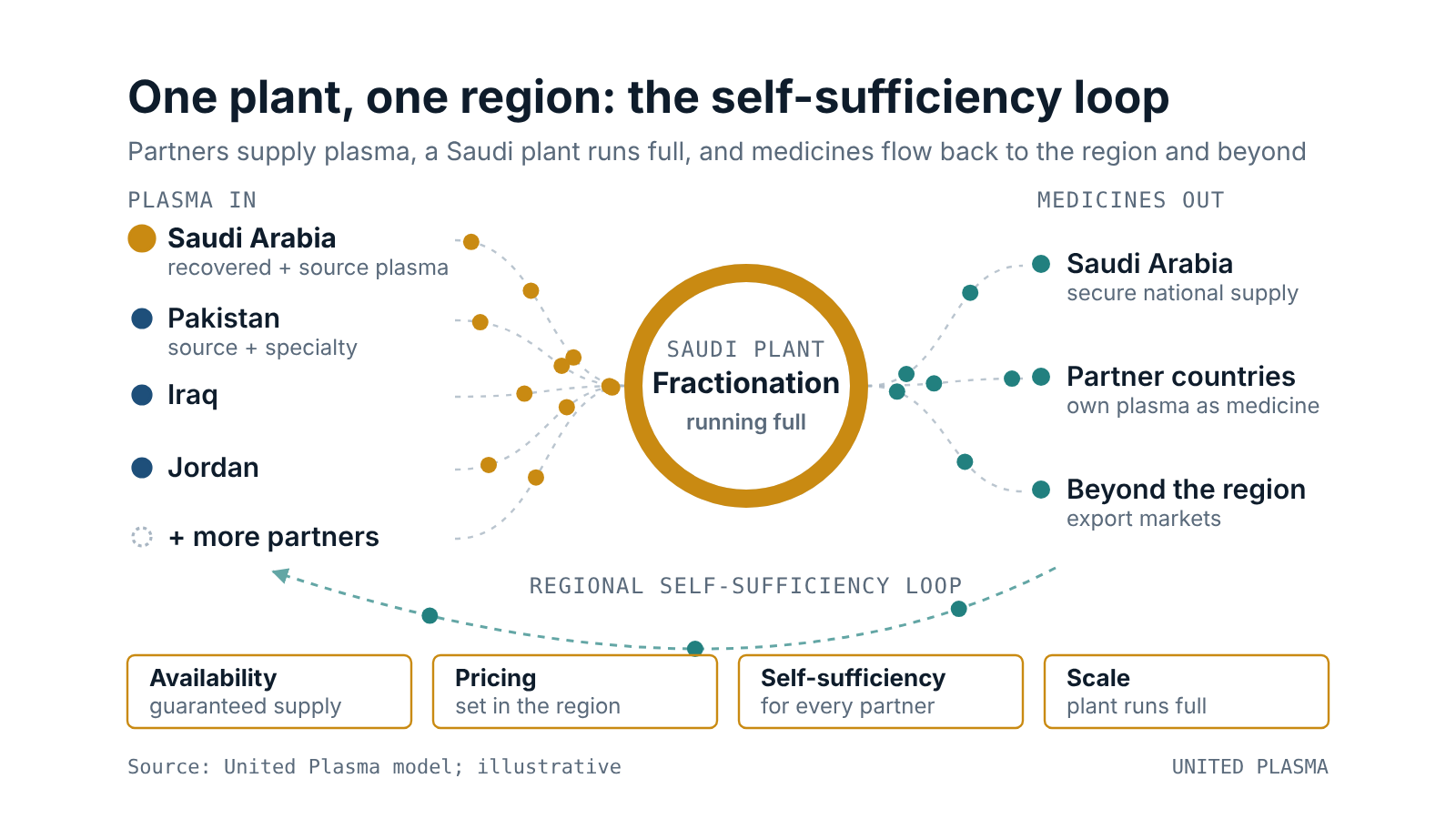
The loop closes on itself. The more partners contribute, the fuller the plant runs and the lower the cost of every vial; the better supplied the partners are, the more reason they have to keep contributing. One model solves several problems at once:
Availability. Supply no longer depends on what global manufacturers allocate to the region in a tight year.
Pricing. Medicines are made where they are used, so price is set by the region's own costs rather than by the global market.
Self-sufficiency for every partner. Countries without a plant of their own still turn their plasma into their own medicines.
Scale. Pooled plasma brings a plant to economic volume years sooner than a single national program could.
No plasma wasted. Recovered plasma that is discarded today becomes a feedstock.
Trust. One quality and testing standard across all partners, with full traceability from donor to vial, meets the requirements of regulators at home and abroad.
Saudi Arabia is the natural home for this hub: it has the largest market in the Gulf, centralized procurement, the capital and industrial policy to build the plant, and the regional relationships to anchor the partnerships. The rest of this analysis sets out what it takes to get there.
How the Kingdom buys plasma medicines today
Nearly all plasma medicines reach Saudi patients through NUPCO, the National Unified Procurement Company. Owned by the Public Investment Fund (Saudipedia), NUPCO buys medicines, devices and supplies on behalf of the Ministry of Health, the military and National Guard health services, specialist hospitals and medical cities (Asharq Al-Awsat). Its scale gives the Kingdom real negotiating power on price.
Price, though, is only half of supply security. September 2023 is the cautionary tale. As global plasma ran short after the pandemic, the SFDA shortage list showed core albumin and immunoglobulin products from several major international manufacturers unavailable in the Kingdom for months:
| Product | Brands and presentations affected | Months unavailable (Sep 2023) |
|---|---|---|
| Human albumin 20% | 2 brands | 15–19 |
| Human albumin 5% | 1 brand | 14 |
| Subcutaneous immunoglobulin | 5 presentations, 2 brands | 6–13 |
| Intravenous immunoglobulin | 1 brand | 12 |
Source: SFDA Shortage Drug List, September 2023.
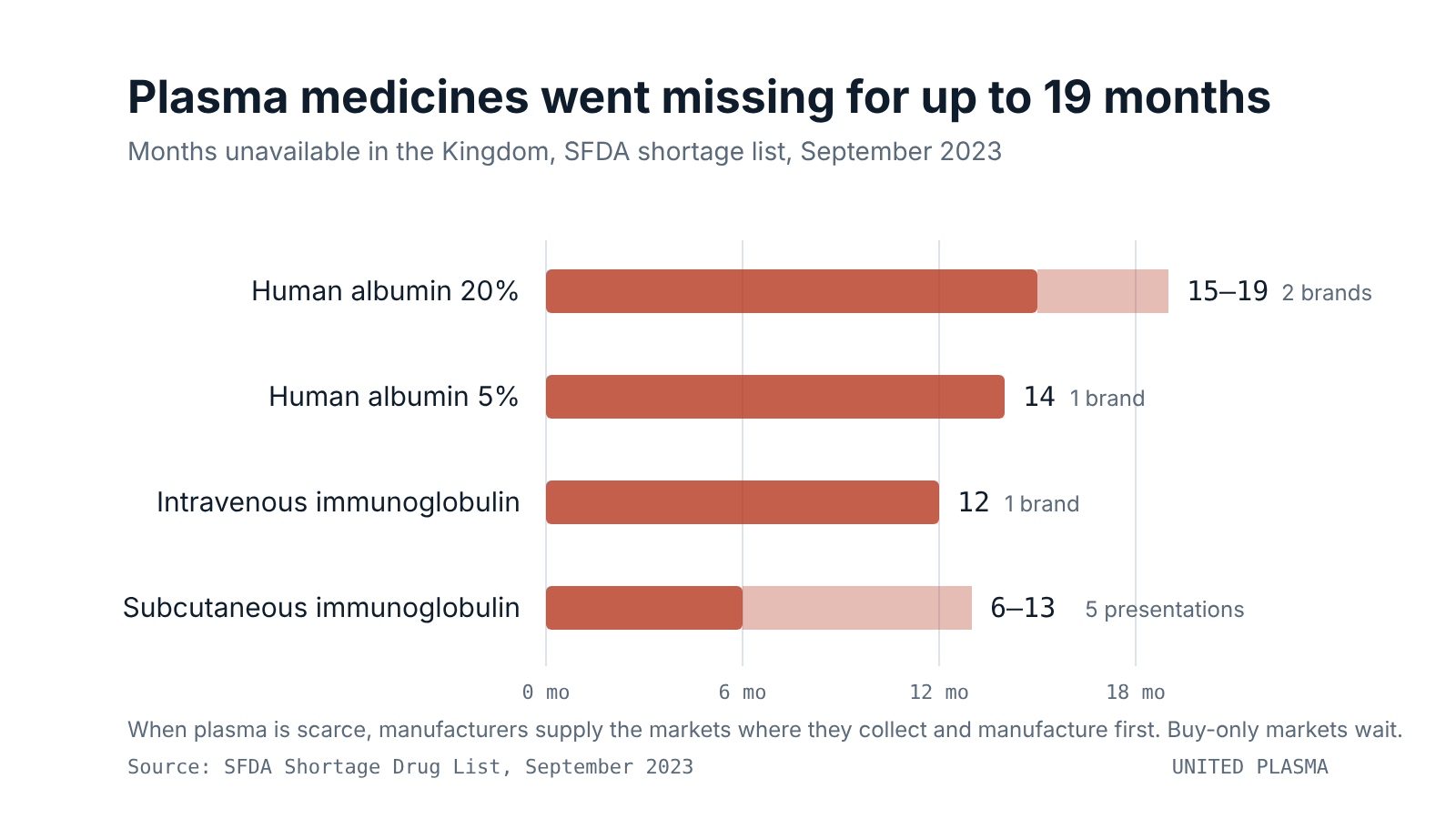
The lesson is structural. When plasma is scarce, manufacturers allocate first to the markets where they collect, manufacture and hold long-standing commitments. A market that only buys, however well, sits lower on that list. Preferred pricing does not change the order of allocation.
Supply has recovered, but it is concentrated
The post-pandemic crunch is over. Donations returned to normal, and pricing has corrected along the chain from raw plasma to finished therapies. U.S. centers collected a record 62.5 million liters in 2025, up 8.4% in a year, largely thanks to next-generation apheresis machines that collect 9–12% more plasma per donation. Independent plasma now sells for about $190 per liter (Jaworski, 2026).
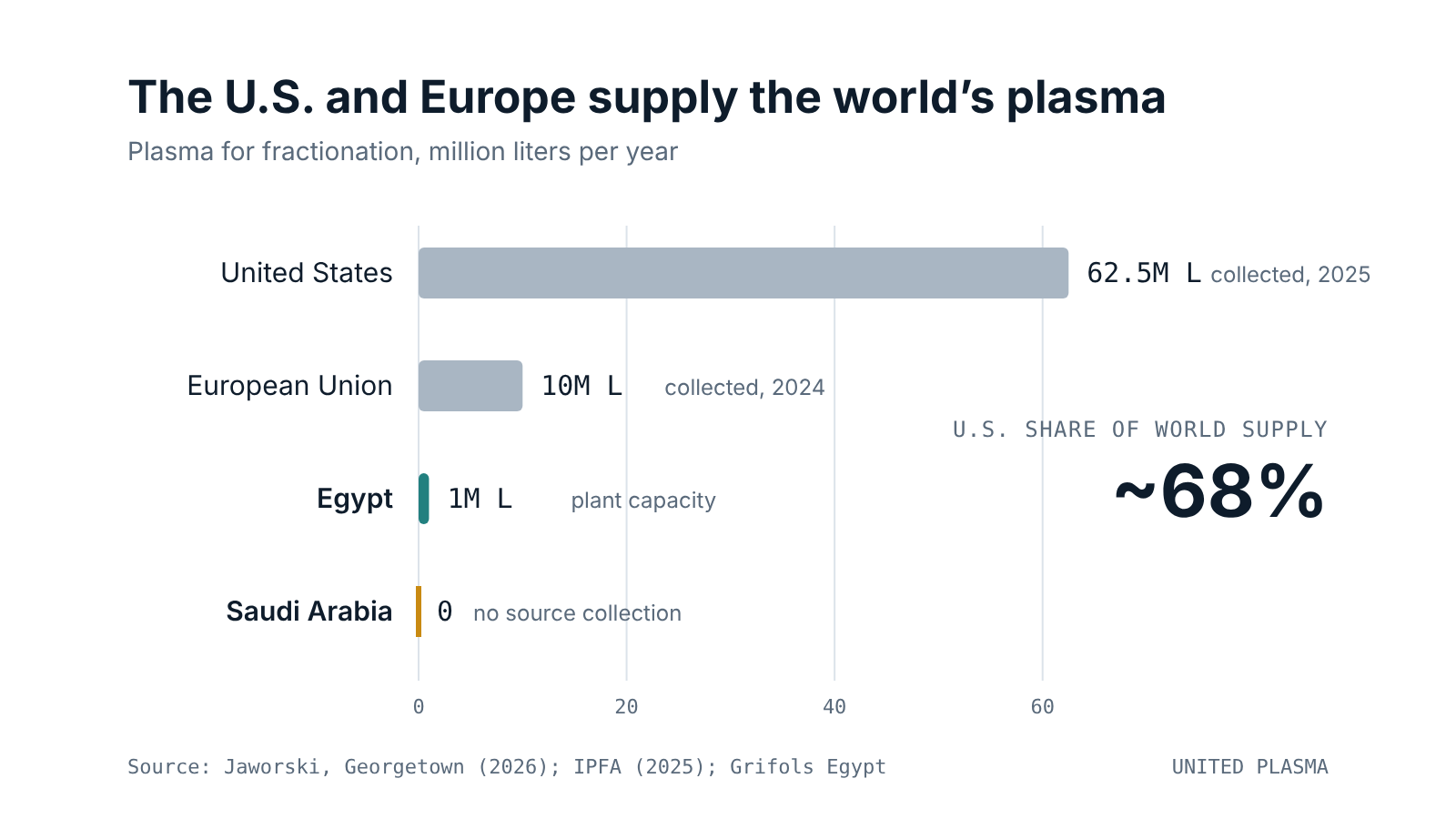
What has not changed is where the plasma comes from. The U.S. supplies roughly 68% of the world's plasma for fractionation, and Europe most of the rest, while Europe itself fell about 8.7 million liters short of its own needs in 2025 (same source). Demand for immunoglobulin keeps growing 6–8% a year. Recovery has made supply comfortable for now, not secure.
In the Middle East, Egypt is the only player that has built collection at scale. Its national program with Grifols went from a first donation in January 2022 to European Medicines Agency approval of its full collection-to-release chain in December 2025 (Pharmaceutical-Tech), and plans about 40 centers and 3 million liters a year by the end of the decade (Ara). Egypt is not yet a plasma powerhouse, but for now it is the only one in the region.
Why demand in the region will keep rising
Global demand drivers apply in the Gulf: aging populations, wider use of immunoglobulin in neurology and immunology, and better access to treatment. But the region has a further driver that most forecasts underweight.
Consanguineous marriage is common across the Middle East and North Africa, at 20–56% of marriages compared with 1–9% globally. Researchers at King Faisal Specialist Hospital link this to a higher prevalence of inherited immune disorders in regional registries than elsewhere in the world (Al-Mousa & Al-Saud, Frontiers in Immunology, 2017). Many of these patients need immunoglobulin for life, and inherited bleeding disorders add demand for clotting factors.
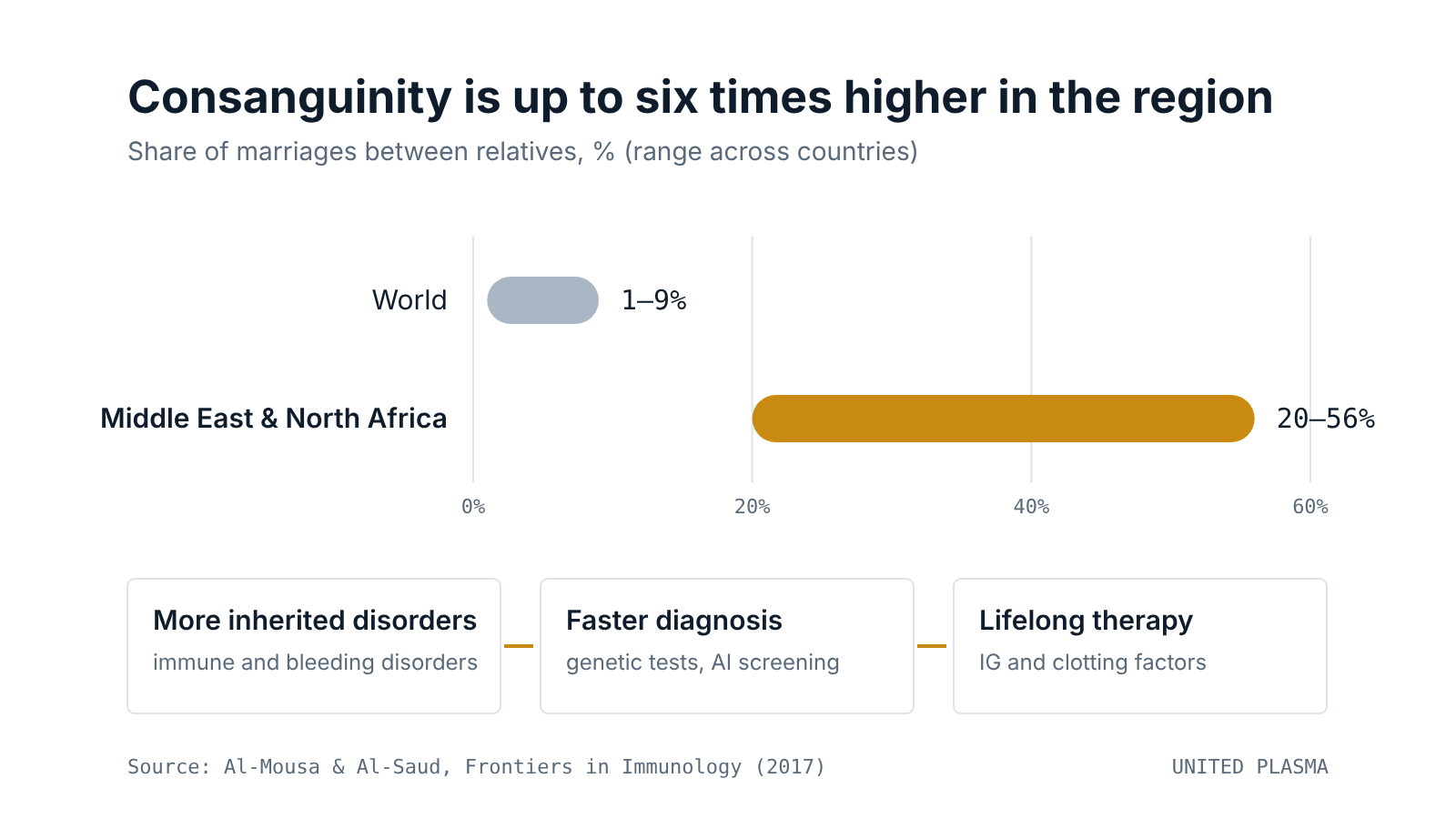
Many of these patients are still undiagnosed. As genetic testing and AI-assisted diagnosis cut the time from first symptoms to diagnosis, more of them will be identified and treated, often from childhood. In our view, that makes demand growth in the Gulf likely to outpace global averages over the next decade.
Recombinant medicines change part of this picture, not all of it. Recombinant clotting factors and newer non-factor therapies now treat many hemophilia patients without plasma. But there is no recombinant substitute for polyvalent immunoglobulin or for albumin, the two products that drive plasma demand and the economics of every fractionation plant. A Saudi strategy can use recombinant products where they fit, and it still needs plasma for the rest.
Localization: self-sufficiency and a regional hub
Saudi Arabia's interest in plasma is part of a wider push to make essential medicines at home. The National Biotechnology Strategy makes local biomanufacturing a core pillar (Nature), and Lifera, the PIF-owned biopharmaceutical company, names plasma therapeutics among its priority products alongside insulin and vaccines (BioPharm International). The ambition is two-sided: secure supply for Saudi patients, and serve neighboring markets from the Kingdom.
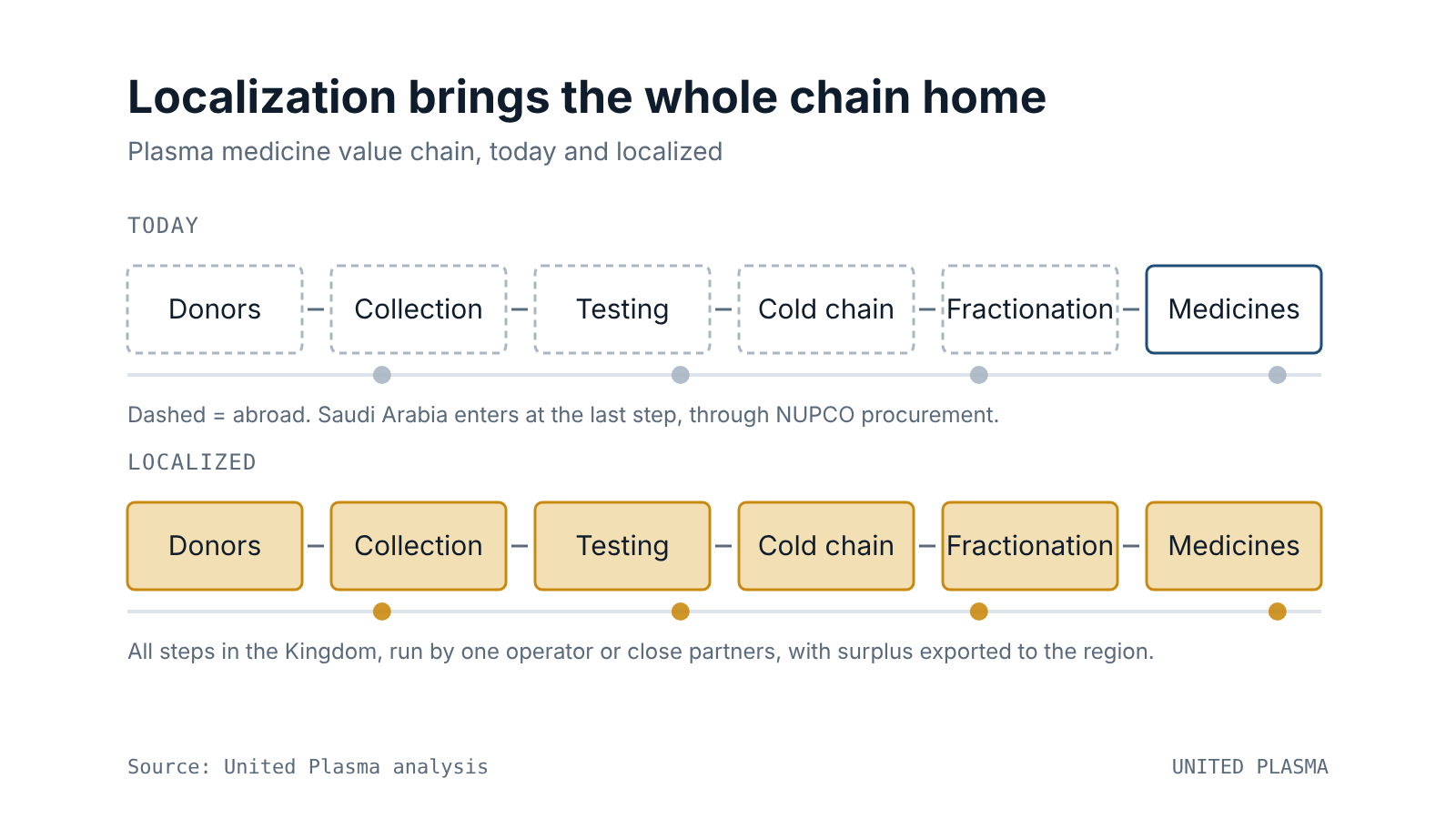
Earlier attempts show why the whole chain matters. A 2020 term sheet between Grifols and the Public Investment Fund for collection centers and fractionation and purification plants (Grifols), and a plasma-derivatives plant planned north of Riyadh in 2021 (Arab News), did not go ahead. No national plasma partner has been announced to date.
One principle follows from the Saudi localization agenda: if plasma is collected in the Kingdom, it is meant to be manufactured in the Kingdom. That shapes who can lead a program. The operator will either own the full vertical, from donor to finished medicine, or work hand in hand with a partner that does. A PIF-owned company such as Lifera is positioned to span both sides, upstream collection and downstream manufacturing. Egypt followed the same logic: its collection network and its fractionation plant were built as one program.
Plasma the Kingdom already has, and loses
Before a single plasma center opens, Saudi Arabia already produces plasma. Every whole-blood donation is separated into red cells, platelets and plasma, and the plasma not needed for transfusion can be fractionated into medicines. This recovered plasma is an important part of national supply in many countries.
In the Kingdom, United Plasma's field work found that much of it is discarded. There is no local fractionation plant to receive it, and current rules do not allow blood or plasma to leave the Kingdom, even under contract fractionation, where a manufacturer abroad processes the plasma and returns the finished medicines to the country of origin.
The volume is meaningful. Each whole-blood donation yields roughly 200 mL of plasma. With more than 900,000 blood donors in 2025 (Umm Al-Qura), that is on the order of 150,000–180,000 liters a year before transfusion needs, by United Plasma's estimate. Today, most of that value is lost.
Two paths would put it to work:
Contract fractionation as a bridge. A targeted exception that lets qualified recovered plasma be processed abroad, with all finished medicines returned to the Kingdom, until a domestic plant is running.
A baseline for the domestic plant. Qualify blood-bank plasma to fractionation standards now, so a future Saudi plant starts with a reliable volume before source-plasma centers mature.
Both paths start the same way: freezing, testing and documenting recovered plasma to the standards fractionators require, which most blood banks are not yet set up to do.
A strategic choice: a national plant or a regional platform
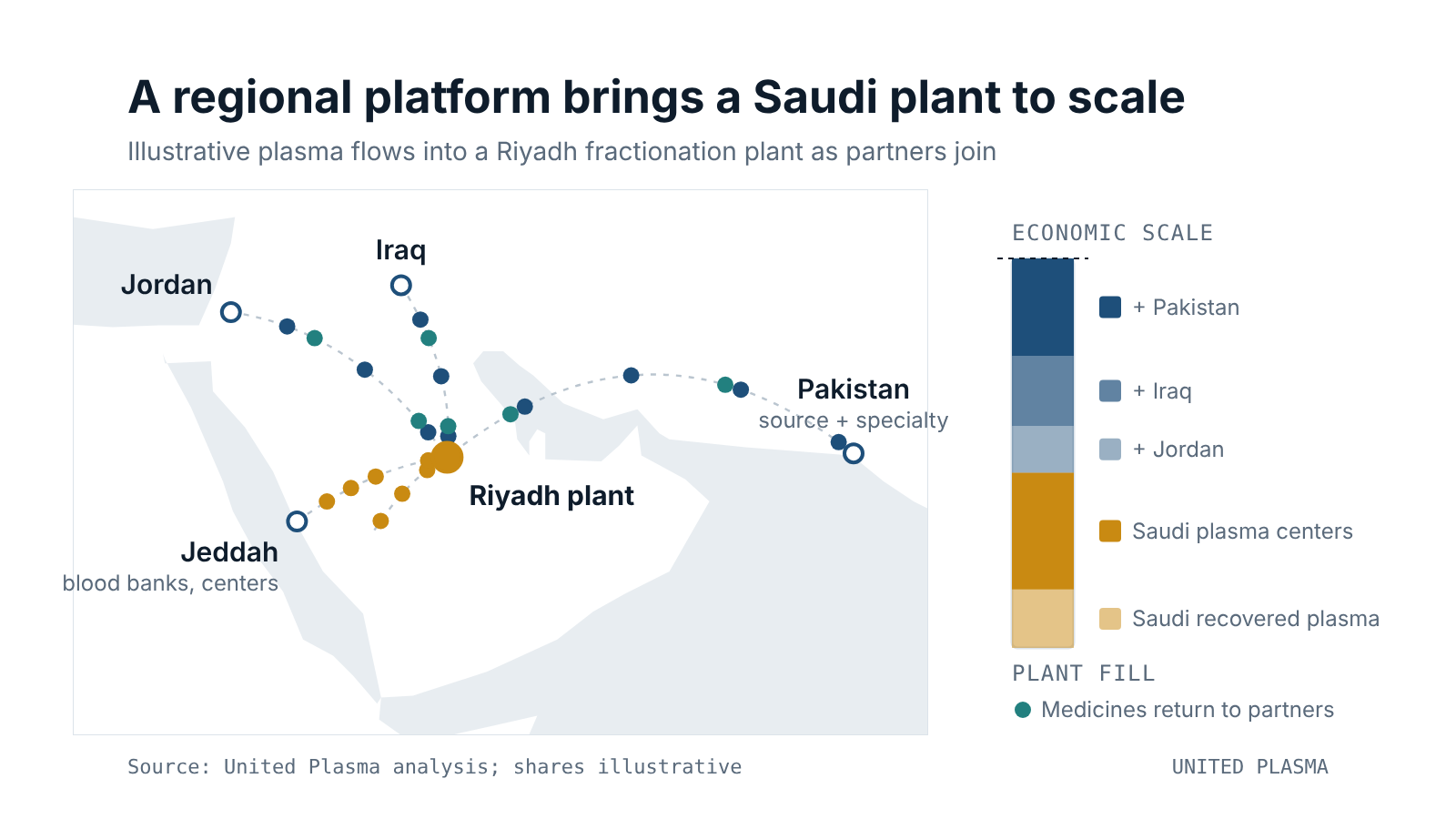
The Kingdom will also have to decide what its fractionation plant is for. One option is a plant fed only by Saudi collections. The other is a regional platform that also draws plasma from neighboring markets where Saudi Arabia invests in, builds or partners on collection.
The case for the regional option is partly arithmetic. Fractionation plants are built at scale: Egypt's plant is sized at 1 million liters a year, expandable to 2 million (Grifols Engineering). Even at maturity, Riyadh and Jeddah could supply around 1.6 million liters a year, and a domestic network would take years to get there. Plasma from nearby markets would fill the plant sooner and keep it running at an economic volume.
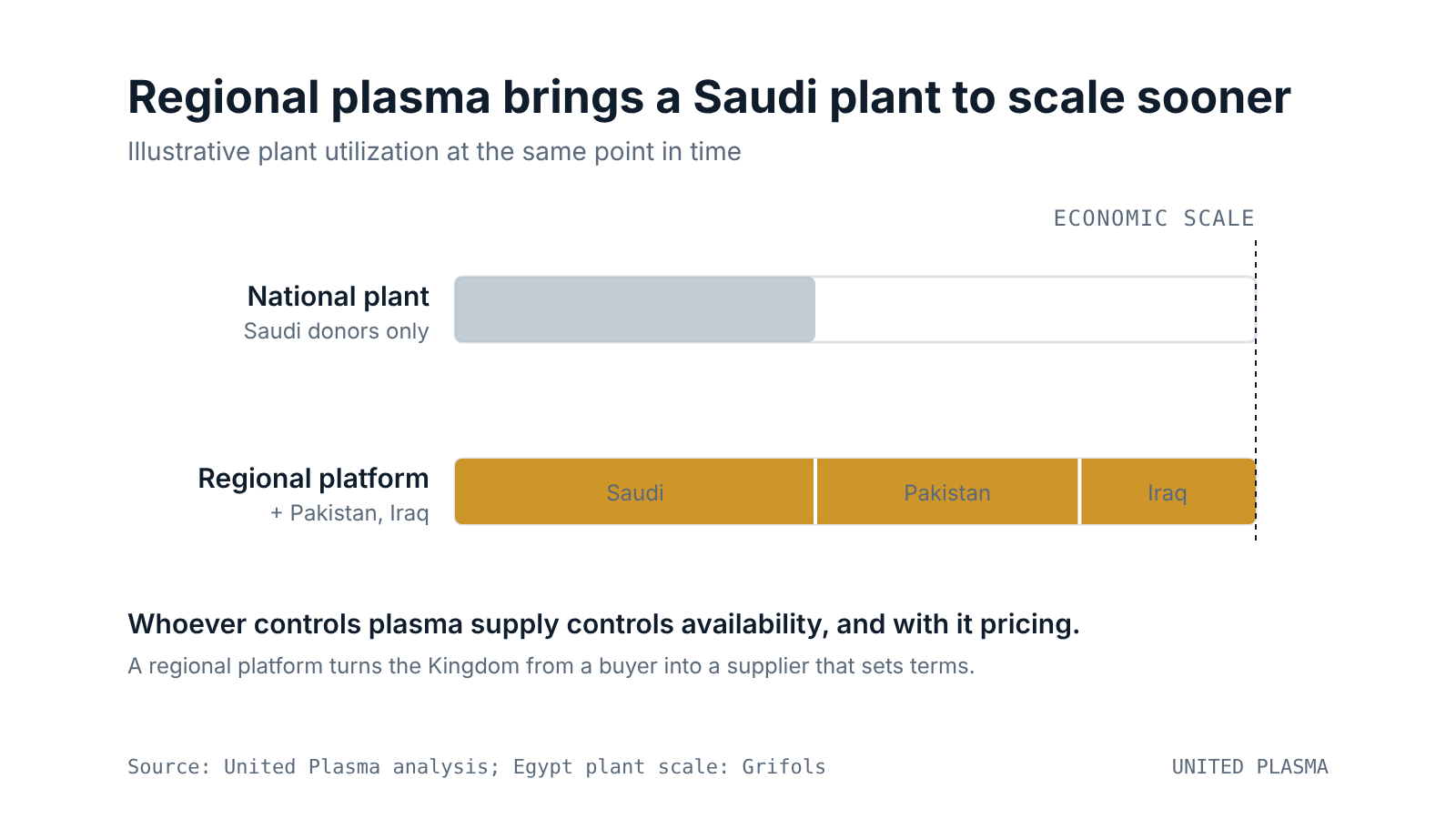
The candidates are clear. Pakistan has a population of more than 240 million and very close political, economic and people-to-people ties with the Kingdom. Iraq is a neighbor with a large, young population. Both could supply normal source plasma and specialty plasma, the hyperimmune plasma used to make targeted immunoglobulins, under Saudi-led quality systems.
The prize goes beyond plant economics. Whoever controls plasma supply controls the availability of plasma medicines, and with it their pricing. A Saudi-anchored regional network would turn the Kingdom from a buyer at the end of the queue into a supplier that sets terms, for the region and potentially for world markets.
The cost picture
Independent price data points to a structural cost advantage for Saudi Arabia on everything priced locally. The World Bank's International Comparison Program puts the Kingdom's overall price level at roughly half that of the United States: an index of 80.7 against 158.5, with the world average at 100 (World Bank ICP 2021). Purchasing-power data for 2023 agrees: about 1.89 riyals buy what one dollar buys in the U.S., against a market rate of 3.75 (World Bank).
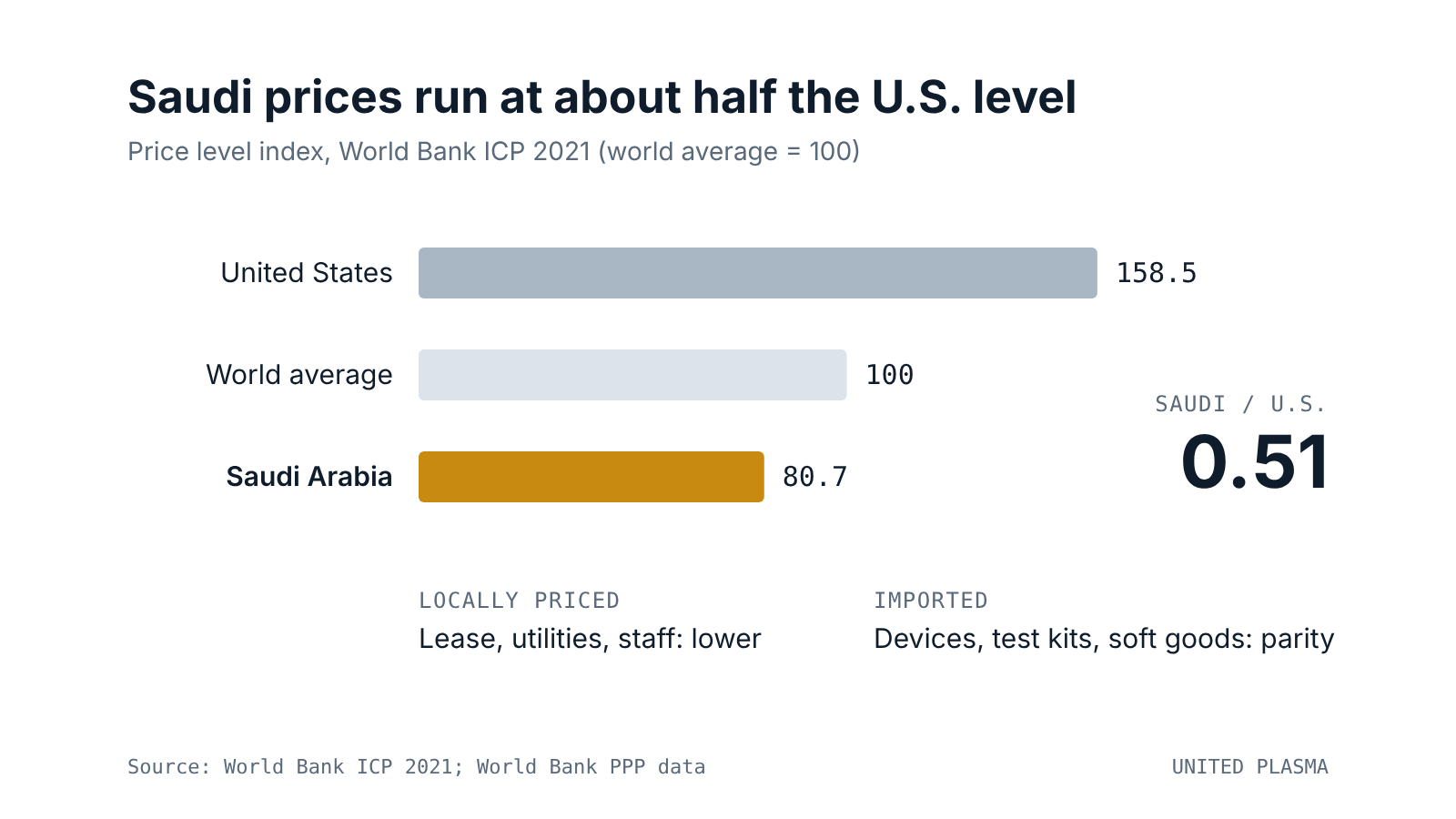
| Cost component | Saudi Arabia compared with the U.S. | Basis |
|---|---|---|
| Donor compensation | Set by national rules rather than a competitive market; expected well below U.S. levels, where donors average about $65 per donation | Saudi legal framework; Jaworski, 2026 |
| Lease, facilities and utilities | Substantially lower | World Bank price level |
| Staff | Lower overall, depending on the staffing model (below) | World Bank price level; field observations |
| Apheresis equipment, soft goods and test kits | Roughly at parity or slightly higher: imported and priced in dollars | Supplier quotes gathered in 2023 |
| Freight | Lower within the Kingdom; higher for exports to Europe | Route-dependent |
Donor compensation is where Saudi Arabia differs most. U.S. fees are set by competition among more than 1,200 centers. In the Kingdom, the amount is set by regulation, and income levels across the resident population, nationals and expatriate workers alike, mean that a modest, fixed reimbursement can be meaningful to donors. That keeps the largest single cost line in a plasma center well below U.S. levels, provided the amount is set fairly and donor welfare is protected.
Staffing is the other open variable. On United Plasma's field visits to Saudi blood banks, we found that much of the workforce is either seconded from government hospitals and health centers, with salaries carried by the state, or made up of volunteers, and that blood itself is not paid for. Whether plasma collection follows that public model, a commercial model, or a hybrid of the two will change its cost structure more than any equipment quote.
United Plasma's line-by-line cost model will be finalized after further on-the-ground validation in the Kingdom. Figures in this article are indicative and drawn from public sources.
Donor compensation and the legal framework
Saudi Arabia has a clear regulatory framework for plasma collection: Council of Ministers Decision No. 415, dated 09/03/2021; the SFDA Guideline on Blood Products (version 1.1, issued 22/08/2017); and the Ministry of Health’s “Conditions to Collect Plasma” (Attachment 46, Article No. 4/15, Issue No. 4). Together they define what counts as plasma donation and how much donors receive. How they will be applied, including donation frequency, eligibility and the operating model for collection centers, is still being worked through.
The Kingdom also starts from a strong culture of recognizing donors. Regular blood donors are honored by the state, including with the Medal of Merit for repeat donors, a distinction open to residents as well as citizens, and with letters of recognition from senior officials. In some cases donors also receive time off and transport support. In 2025, more than 900,000 people gave blood, and the national campaign launched by the Crown Prince in October 2026 recorded a 100% voluntary donation rate (Umm Al-Qura).
That matters for plasma. The question is not whether to recognize donors, which the Kingdom already does, but how a plasma program's compensation sits alongside a blood system built on voluntary giving.
Protecting the blood supply
The most delicate part of any Saudi plasma program is making sure that paying for plasma does not draw donors away from blood banks. Blood donation has grown sharply in recent years, but hospitals still face recurring shortages, and charity blood banks, which have done much to close the gap, still have a long way to go.
The international evidence is reassuring but not conclusive. Canada's expert panel found "no evidence to suggest that commercial plasma collection negatively affects the supply of whole blood," while stressing that monitoring is still needed (Health Canada, 2018). The Saudi context is different enough that the risk has to be designed out, not assumed away.
United Plasma has developed several scenarios for this, including a hybrid blood-and-plasma donation model in which one system recruits and compensates donors for both, so that plasma strengthens the blood supply instead of competing with it. Whichever model is chosen, the safeguards are the same:
One national donor registry covering blood and plasma, so donation intervals protect donor health and planners can see where donors move.
Clear triggers that pause plasma expansion in any region where blood donations fall.
Separate recruitment that brings in new donors rather than drawing on existing blood donors.
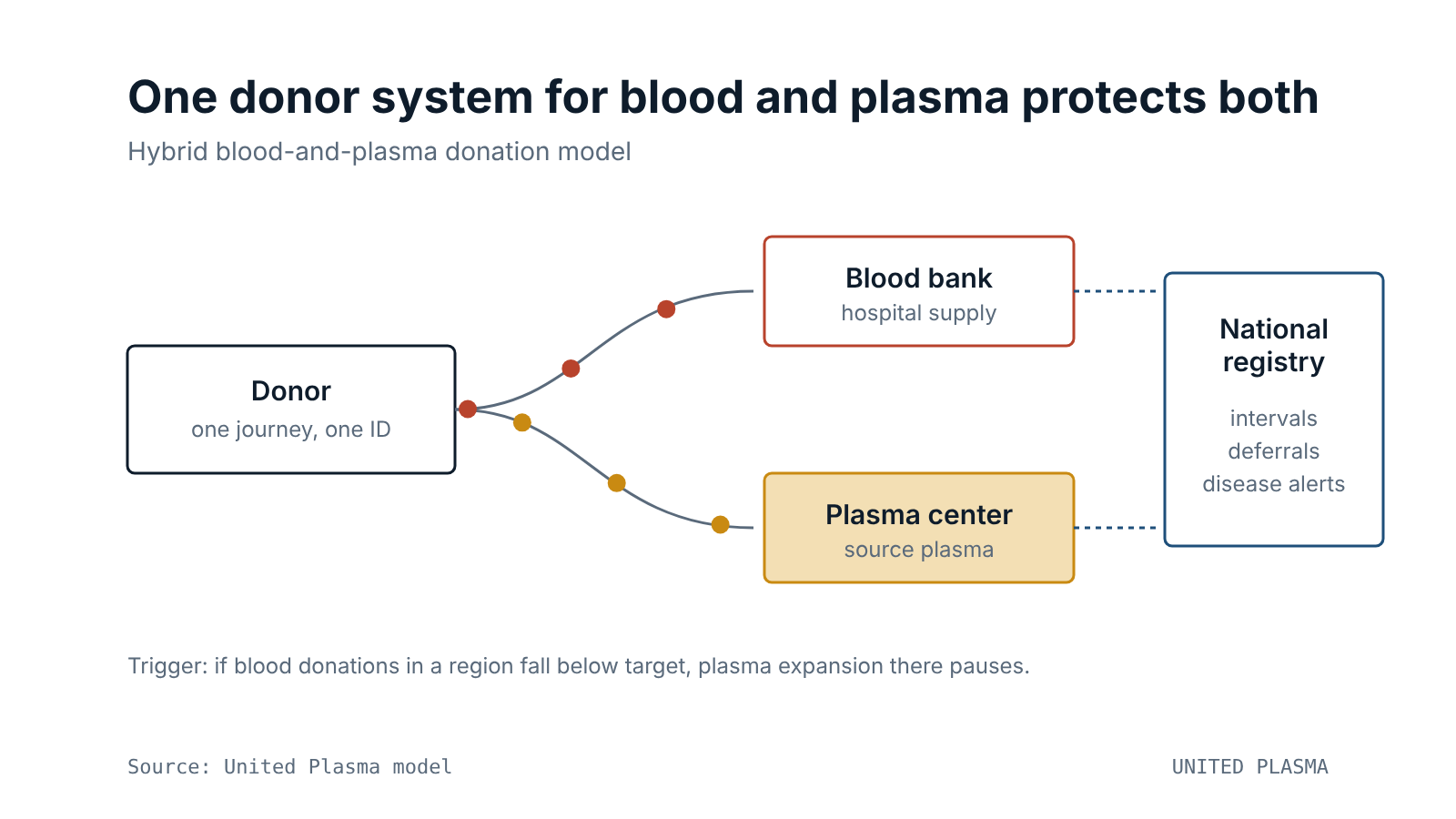
The Kingdom is also well placed on donor screening. From our conversations with Saudi health officials, the authorities are working toward a unified communicable-disease alert system linked directly to national health records. Once in place, it could give plasma centers deferral information more complete and more current than the industry-run deferral registries used in the United States.
Donors, scale and geography
The donor base is large enough. Using city populations from the 2022 census, Riyadh (7.0 million) and Jeddah (3.75 million) alone could support about 1.6 million liters a year at maturity (Saudipedia), room for 25 or more centers. What will decide output is not headcount but loyalty: a plasma center depends on repeat donors, and retaining them matters more than recruiting them.
Three donor-side factors shape the design:
Women donors. Women made up only 2.5% of Saudi blood donations in 2020 (PMC). Women-only donor areas and female staff are a requirement.
Deferral rates. Inherited blood conditions are common in parts of the Kingdom, so first-visit deferrals will run higher than in the U.S.
Residents and nationals. Non-Saudis are about 42% of residents (Saudi Gazette); whether and how they can donate changes the size of the pool.
- Saudi hub
- Collection market
- Partner or competitor
- Watchlist
- ×Excluded: conflict
- Export route
- Disrupted route
United Plasma analysis · schematic, not to survey scale
Geography now carries as much weight as demographics. Since February 2026 the closure of the Strait of Hormuz has pushed Saudi exports toward the Red Sea (Al-Monitor). A frozen-plasma supply chain should follow the same logic: run the network from Riyadh, export through Jeddah, and treat Gulf-coast routes as secondary. Jordan is the most practical near-term expansion market, with Iraq and Pakistan to follow; Syria belongs on a watchlist, and Sudan and Yemen are out of scope while conflict continues.
Seven conditions for success
A Saudi plasma program is feasible. Whether it succeeds depends on decisions made before the first center opens.
Own the whole vertical, or partner with whoever does. Collection in the Kingdom means manufacturing in the Kingdom. The program needs an operator that runs donor to finished medicine, or a collection operator working closely with a domestic manufacturer, such as a PIF-owned company that can span both.
Decide the plant's sources early. Recovered plasma from Saudi blood banks, Saudi source plasma, and regional partners such as Pakistan and Iraq. Each needs a decision now, starting with the rules that keep recovered plasma from being used.
Protect the blood supply first. A hybrid or coordinated blood-and-plasma model, one national donor registry, and clear triggers to pause expansion if blood donations fall.
Apply the compensation rules carefully. The legal framework exists. Its application, on frequency, eligibility and amount, should treat compensation as reimbursement of time and costs and protect donor welfare.
Build to international standards from day one. SFDA licensing plus EMA Plasma Master File requirements, a qualified NAT and viral-marker testing lab, and integration with the national disease-alert system.
Start with a disciplined pilot. Two centers, Riyadh and Jeddah, scaling only when donation volume, donor retention, cost per liter, compliance and blood-supply indicators pass agreed thresholds.
Design for resilient logistics. Cold storage and export around the Red Sea, with redundancy and force-majeure terms in offtake contracts.
A domestic plasma supply protects a health system against disasters, wars, pandemics and market swings. Cost per liter decides whether a collection program lasts; national resilience is why governments build one.
How United Plasma solves it
Every challenge in this analysis has a working answer, and United Plasma delivers all of them as one integrated program. Our approach is simple: collect more plasma, efficiently and compliantly, at the lowest sustainable cost per liter, with every part of the system built to flow into the next.
| Challenge | United Plasma solution |
|---|---|
| Blood supply versus plasma | Hybrid blood-and-plasma donation models, separate donor pathways, and national safeguards with clear triggers that protect the blood supply |
| Donor compensation and regulation | Compensation frameworks aligned with national law, and the full regulatory pathway: SFDA licensing, EMA Plasma Master File and U.S. FDA |
| Donor recruitment and loyalty | Donor experience and retention programs, women-only donor facilities, and community education designed for the region |
| Testing | Qualification of NAT and viral-marker laboratories to EMA standards, with interim testing arrangements until local labs are approved |
| Systems and the national database | Donor management systems that link with national ID, health records and the communicable-disease alert system, with one registry across blood and plasma |
| Cold storage and logistics | Freezer and cold-storage design, inventory hold and look-back procedures, redundancy, and Red Sea export routing |
| Workforce | Training academies, SOPs and a localization path for clinical and quality staff |
| Quality and compliance | Quality management systems, audit readiness for regulators, manufacturers and partners, and ongoing compliance monitoring |
| Vertical integration and regional sourcing | Structuring of collection-to-fractionation partnerships and design of regional collection networks for source and specialty plasma |
| Recovered plasma | Qualification of blood-bank plasma for fractionation, freezing and documentation protocols, and contract-fractionation structures that return every finished medicine to the Kingdom |
| Cost per liter | Lean center design, throughput and donor-retention optimization, and selection of next-generation collection devices |
We build plasma systems from the ground up, from national policy to the first donor, to FDA, EMA, MHRA and MHLW standards.
The full feasibility report
This article summarizes United Plasma's complete feasibility study and implementation plan for a Saudi plasma program. The report is updated every year, with interim updates when regulation or market conditions change, and is available on request to governments, investors and industry partners. It covers:
Donor-base modeling for Riyadh and Jeddah from 2022 census data
Five-year output projections for one- and two-center pilots
Operating-model options, including public, commercial and hybrid blood-and-plasma models, plus recovered-plasma and contract-fractionation options
A cost framework comparing Saudi and U.S. inputs, with detailed costing following field validation
The regulatory pathway across SFDA, the EMA Plasma Master File and the U.S. FDA
Vertical-integration and partnership structures, and regional sourcing options for a Saudi fractionation plant
An implementation timeline from contract signing to first donor, with compliance gates
A regional expansion assessment and geostrategic risk map
To request the report, contact [email protected].
About United Plasma. United Plasma designs and builds plasma systems from the ground up, from national plasma policy to fully operational collection networks, testing, cold chain and donor systems, built to FDA, EMA, MHRA and MHLW standards. We advise governments, collectors, fractionators and the vendors that serve them, across the Middle East, North Africa, Asia, Europe and the Americas.
Sources
America's Plasma Contribution to the World: 2025 — P. Jaworski, Georgetown (Jan 2026)
Grifols secures EMA approval for Egypt value chain — Pharmaceutical-Tech (Dec 2025)
Grifols and the Public Investment Fund term sheet — Grifols (Feb 2020)
MODON leases land for plasma derivatives plant — Arab News (Apr 2021)
Crown Prince launches 2026 national blood donation campaign — Umm Al-Qura
Final report of the Expert Panel on Immune Globulin Product Supply — Health Canada (May 2018)
Saudi economy shrinks 4.8% amid Iran war — Al-Monitor (Jul 2026)
This article is for general information only. It draws on public sources and United Plasma’s own analysis, all figures are indicative estimates, and nothing here is investment, legal or regulatory advice. United Plasma does not speak for any government, regulator or company named.